
How I’d Build the Content Strategy for Your Online Business From Scratch
Because it’s time to stop staring at a blank content calendar…
There are endless ways to create content for your online business, and a million strategies to help you do it. Social media, Pinterest, SEO, long-form video, webinar funnels, ads…the list continues to grow by the day.
As someone who’s been studying content marketing for 8+ years, I’ve learned that there’s no perfect formula that works for everyone. So why am I writing an entire article telling you the exact strategy I’d build for you?
Because over those 8 years, I’ve also learned that there are a few foundations you can build right now that make creating content a lot easier. And I don’t want you wasting any more time staring at a blank content calendar, wishing you had a plan that worked. Or changing strategies every few months when something you tried didn’t create results right away.
If you’ve been struggling to find a strategy that sticks, here’s exactly what I'd do if I was building your content strategy from scratch:
Step 1: Get to know everything about your brand
Before we choose a content marketing platform or brainstorm any content ideas, we need to define your brand and what sets it apart. That way, your content can:
Reflect your lived experience and expertise
Resonate with your ideal client
Showcase the value of your offer
These three elements make up your brand’s messaging strategy— who you are (your story), who you help (your ideal client), and how you help them (your offer). By creating your messaging strategy first, we make sure that every piece of content is connected back to what you’re selling (even if it’s not promoting your offers specifically). Many business owners skip this step and as a result, their content can sometimes feel generic, random, or disconnected from their offers.
In order to create your messaging strategy, I’d invite you to one of my Content Clarity Sessions and ask you questions like:
💭 What challenges were you facing before starting your business, and what steps did you take to tackle them?
💭 What do these challenges have in common with the challenges your ideal client is facing?
💭 What internal stories do your ideal clients tell themselves about why they can’t overcome these challenges?
These sessions are not only a great opportunity for me to understand the “why” behind your business, but also for you to reconnect to your messaging as well. Especially if you’ve struggled to communicate the value of your offers in the past, or understand who you’re here to serve.
Sometimes having a sounding board is the best way to gain clarity on these deeper questions, and that’s exactly what I help my clients do (before we create any content together).
Step 2: Perform some market research
Once I have a deeper understanding of your brand, I’d dive into your client testimonials and competitor research to uncover what your dream clients are actually saying online. Which part of their problem are they struggling with most, and how do they feel once it’s been solved? What are the biggest questions they’re asking in community forums and comment sections?
Analyzing this research helps me create content that reflects your ideal clients’ real lived experience. It also reveals the unique messaging you can share in your content that similar businesses are missing.
Step 3: Create your email marketing foundation
After developing your messaging strategy, there are two things I’d build or refine to help you create content that brings new clients into your business:
A lead magnet that solves a specific problem
An email welcome sequence that introduces subscribers to everything you have to offer
Even if you already have these foundations in place, it’s worth giving them a second glance to make sure they align with your new messaging strategy and the problem you’re here to solve.
An irresistible lead magnet:
Your lead magnet should solve a small problem while pointing readers towards the larger solution you provide. Lead magnets that give subscribers a quick win build trust quickly and motivate them to continue taking action.
Rather than brainstorming lead magnets around broad topics, I’d identify a specific challenge your client is experiencing and teach them how to solve it with the least amount of time and effort. That way when they receive your follow up emails, they’re excited to keep learning from you.
Specific lead magnets are also a lot easier to promote because the transformation is clear and easy to understand.
An email welcome sequence
The main goal of your welcome sequence isn’t to sell anyone anything….yet. It’s to help your subscribers understand who you are in the context of their own journey. Why you? Why now?
Your email welcome sequence is your best opportunity to make a first impression. According to these statistics, here’s why:
⚡ Welcome emails generate 4x more opens and 5x more clicks than regular email marketing campaigns.
⚡Welcome emails receive 320% more revenue per email than promotional campaigns, with conversion rates 9x higher than typical emails.
⚡ Subscribers who receive a welcome email show 33% more engagement with the brand over time.

And yet, only 57% of businesses send welcome emails to their email list. Your welcome sequence matters…and I’d help you make it count.
Step 4: Choose a long-form content marketing channel
Once your email marketing foundations are in place, it’s time to start creating content! I recommend most businesses choose a long-form content marketing channel for a few reasons:
Long-form content has a longer shelf life than short-form content.
You can dive deeper into specific topics to build authority in your industry.
You can host it off of social media and on a platform you own (like your email list or website).
It’s easier to repurpose across multiple channels to maximize visibility.
The format you choose depends on how you communicate best.
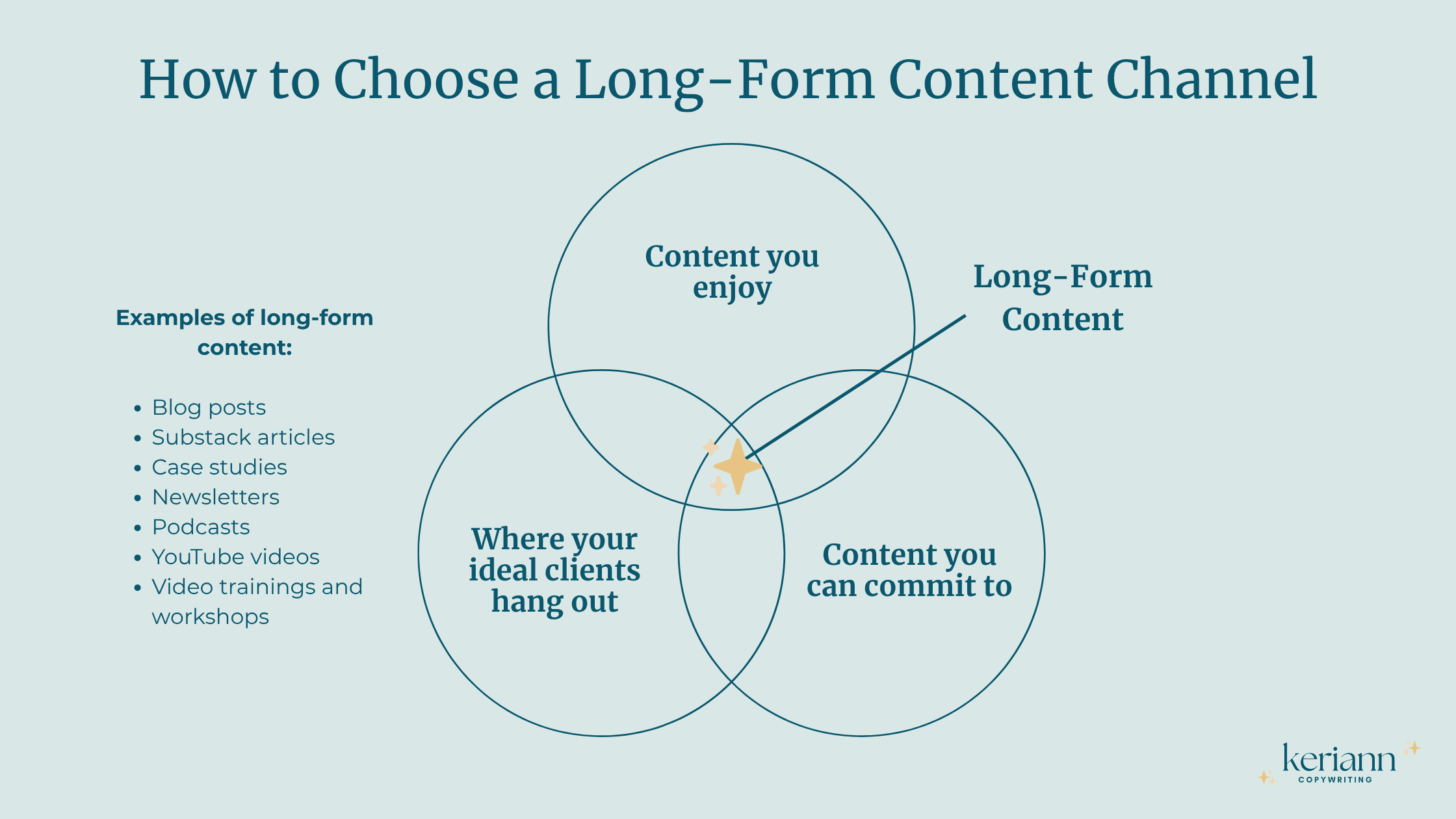
If you’re a yapper like me, you may excel at podcasting where you can interview friends and chat about your favorite topics (without having to be polished or stick to a script). If you enjoy teaching, you may prefer the more scripted structure of YouTube or creating trainings for private online communities (like Facebook groups or memberships). If you excel at writing, you can publish blog posts to your website or start a Substack.
The best long-form content channel is usually a blend of what you enjoy, what you can commit to, and where your ideal clients already hang out.
(And if you can’t commit to creating consistent long-form content yourself, you can always hire someone like me to do the heavy lifting for you!)
Step 5: Create a library of evergreen long-form content
After you’ve chosen a long-form content marketing channel, I’d help you come up with four evergreen content ideas that reflect the main pillars of your messaging strategy. This includes:
Educational content like comprehensive how-to guides, myth busting, and breaking down common mistakes so people can understand their problem better.
Relatable content featuring your juiciest hot takes and personal anecdotes from your lived experience so people can understand you better.
Inspirational content to help your audience overcome limiting beliefs that are holding them back so people can understand themselves better.
Promotional content that showcases your unique process, superpowers, and client results so people can understand your solution better.
I’d help you come up with the strategy and outline behind each post so you know exactly what to talk or write about.
Every piece of content would have an intentional call to action—whether that’s promoting your lead magnet, or pointing towards one of your offers. And because it’s evergreen, you can repeat the messages in your content library again and again.
Which leads me to….
Step 6: Repurpose that content into short-form content
While you’re creating your long-form content, I’d be working behind the scenes to repurpose each piece of content into at least four short-form posts to share on social media. That way you can increase your visibility, promote your lead magnet, engage with your community, and start building consistent relationships.
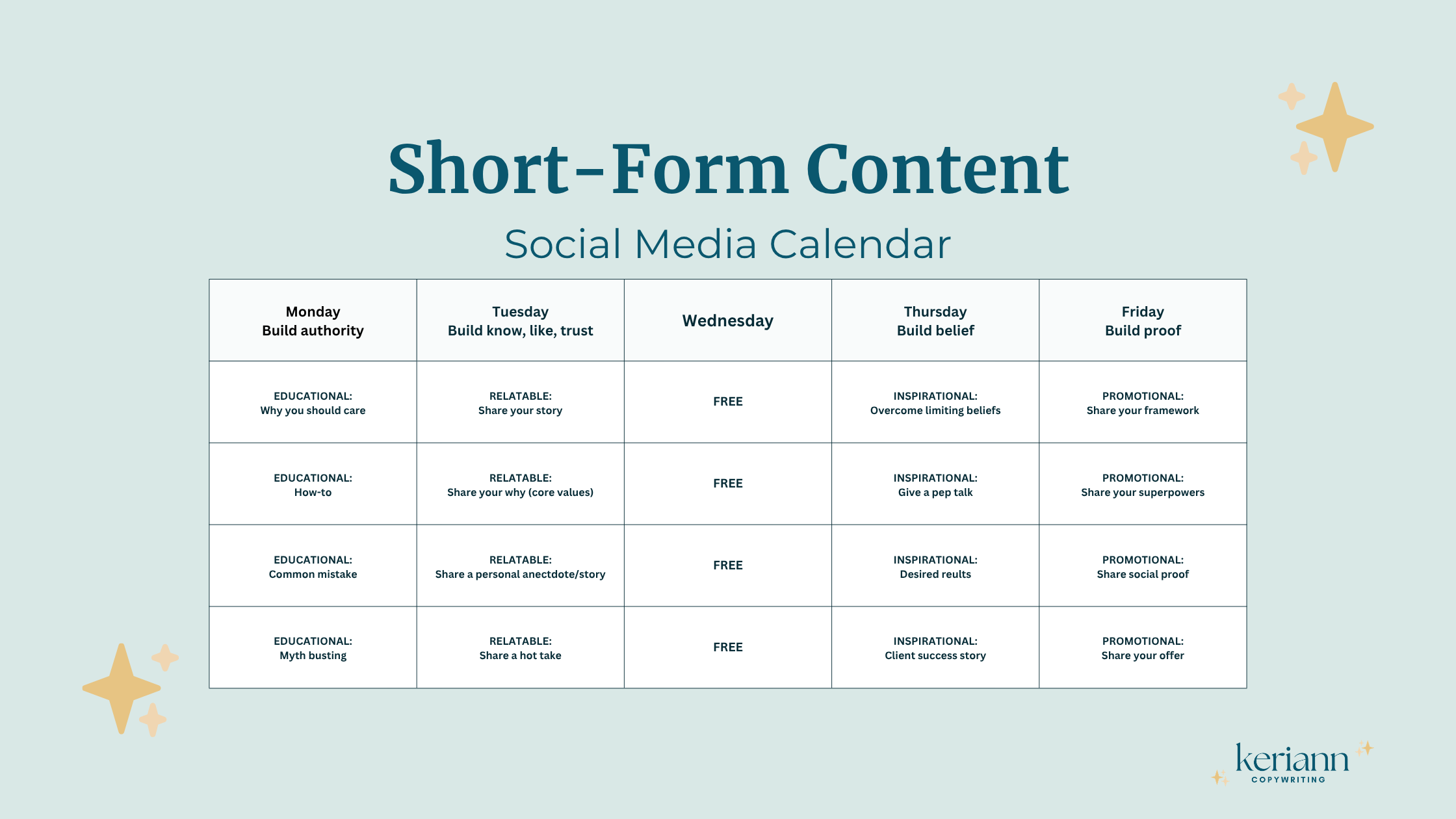
Here are a few ways’ I’d repurpose your long-form content:
Take the main points and turn them into a short-form video series or a roundup-style post
Choose the most interesting educational section and do a deep dive
Grab an inspirational quote that challenges the way your audience thinks about this topic and offer them a reframe
Tell a personal anecdote from your life or an experience with a client that inspired the original post
Implementing a repurposing strategy is great because instead of coming up with new ideas week after week, you can recycle the same messaging on different platforms. The repetition creates clarity for your audience about who you are and how you can help them (and less work for you of course…a win-win!).
Step 7: Rinse, repurpose, and repeat
Before we take this home, let’s recap. By the end of step six, you’d have:
A custom messaging strategy that represents your brand
One lead magnet to help you grow your audience off of social media
An email welcome sequence that introduces people to your offers
4 pieces of long-from content you can refer to again and again
16 pieces of short-form content to boost visibility and build community
From here, I’d encourage you to continue creating long-form content on a consistent basis until you have a library of 12 solid posts.
Then you can either keep creating new content, or promote your existing content and lead magnet to new audiences through strategies like paid advertising, podcast guesting, or collaborations with other business owners (think summits, bundles, and workshops!).
Depending on how often you want to bring new clients into your business, I’d then help you choose an ongoing posting schedule you can maintain over time. And that looks different for every business owner.
Let’s build your content strategy together
Whether you need help clarifying your messaging, building your email foundations, or implementing your strategy, I’d love to help bring your content to life. Here’s how we can work together:
✨ The Content Clarity Guide: For the online business owner who wants to build their messaging strategy and map out a custom content plan that reflects their authentic voice and speaks to their ideal client.
✨ Custom Email Sequences: For the online business owner who wants to grow their email list with the right subscribers, nurture them with care, and promote their offers using the power of automated emails.
✨Ongoing Marketing Support: For the online business owner who’s ready to cross ‘content creation’ off their to-do list and start creating long-form and short-form content more consistently.
Book a free discovery call below and let’s brainstorm what a consistent content strategy for your business can look like:

Hey, there! I’m Keriann
I help online coaches, practitioners, and service providers turn their expertise into strategic and engaging content.
